Ever wondered why every program seems to leave a number behind when it dies?
It doesn’t leave a log, a message, or an error object, just a number like 0, 1, 2, or 127. Some arbitrary little integer that somehow manages to survive the death of the program that produced it.
That tiny number can tell you something about how the program ended, and sometimes, it tells a much bigger story than you’d expect.
If you've written software on Linux or macOS, you've probably encountered this without ever thinking much about it. If you've written shell scripts, you've probably relied on it. If you've worked with CI pipelines or containers, you've almost certainly depended on it.
But why is this even a thing?
Why should a program that has finished running need to tell anyone how it finished?
And why did Unix choose a number?
You could imagine a much more expressive system.
A program could finish and leave behind something like:
status: failure
reason: file not found
severity: error
Or perhaps a structured object containing everything its parent might want to know.
Instead, Unix gave us something much smaller. And somehow, that tiny decision became one of the most persistent conventions in computing.
When the people building the first Unix systems started thinking about how programs should behave, they weren't designing isolated applications. They were trying to build a system where small programs could be combined, replaced, redirected, scripted and composed in ways their creators couldn't possibly predict.
And that raises a much more interesting question:
What should one program be allowed to know about another program?
The answer Unix eventually arrived at was surprisingly minimal. A program didn't need to explain itself.
It just needed to leave behind enough information for whoever launched it to decide what to do next. And one of the pieces of that information was a tiny integer.
That integer is still with us. To understand why, we must go back to where the story starts.
In the early 1970s,
Unix was still young, and its world was much smaller.
There were processes, files, terminals, programs that could start other programs.
And there was a particularly important relationship hiding underneath all of this:
a process could have a parent.
One process could create another, and the new process became its child, that relationship sounds mundane today, but it created a very practical problem.
Suppose I am a program, and I start another program.
Maybe I start a compiler, or a text-processing utility, or any program for that matter.
Eventually, that child program will finish. What am I supposed to know about what happened?
Did it finish normally? Did it encounter an error? Did something external kill it? Did it even finish at all?
And this is where early Unix made a remarkably small interface.
exit
In the second edition of the Unix Programmer's Manual, dated June 1972
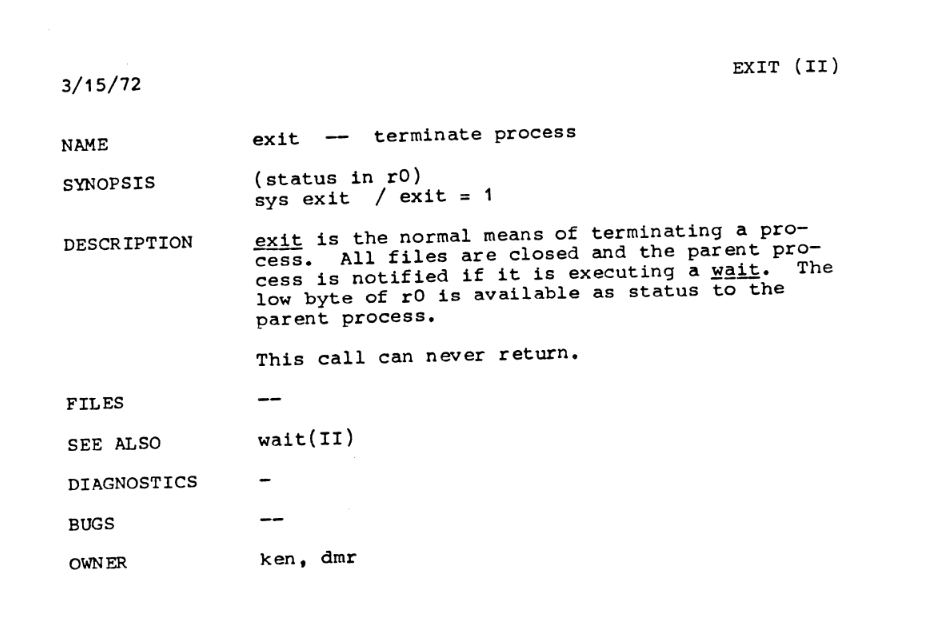
It says that exit is the normal way for a process to terminate. It closes the process's files, notifies the parent if the parent is waiting, and makes the low byte of a register available to the parent as the process's status.
That's it. No elaborate error object. No metadata structure. No human-readable explanation.
Just a small piece of information passed from a dying process to its parent.
And there was another system call sitting right beside it:
wait .
It's job was, essentially, to let the parent wait for one of its children to die and then find out what happened. The Unix Fourth Edition manual from 1973 describes wait explicitly as "wait for process to die" and documents that the parent could retrieve both the child's exit value and information about how the process terminated.
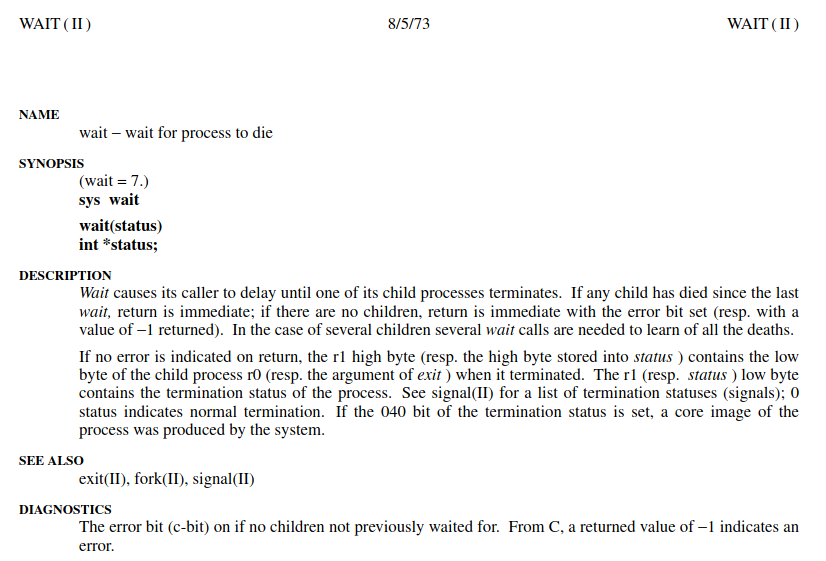
This gives us the first version of the conversation:
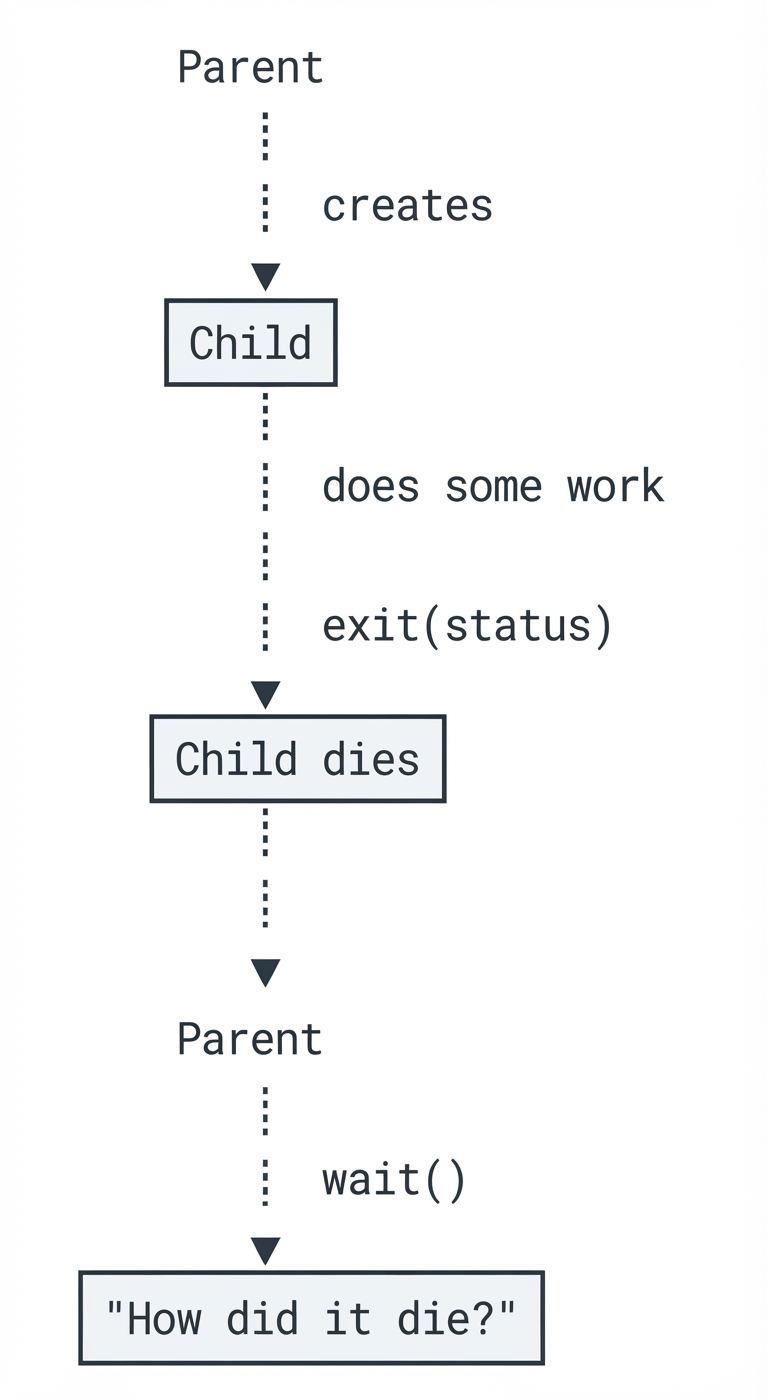
That tiny exchange is the foundation of the whole story.
But there's something important to notice here.
The system wasn't merely asking:
"Did the program return a value?"
It was asking a slightly bigger question:
"How did this process terminate?"
And early Unix already had more than one answer.
A process could terminate normally through exit.
Or it could be terminated by something like a signal.
The wait interface therefore needed to distinguish between these cases. By the time of the Third Edition manual in 1972, the termination information was already split into separate pieces: one part carried the value supplied by exit, while another represented the reason for termination, including signals such as illegal instructions, memory violations, interrupts, and kill. A zero termination status indicated normal termination.
That is a much more powerful idea than it first appears.
Because once programs can communicate their outcome without knowing anything about each other, you can start connecting them together.
And that is exactly where Unix gets interesting.
The shell wasn't going to be the last thing that consumed these status values.
It was about to turn them into something programmers could compose.
When Programs Started Talking to Each Other
The shell is where this tiny status becomes more than a report about a dead process.
A command finishes. The shell gets its status. And now it can make a decision about what happens next.
make && ./program
That && means:
Run
./programonly ifmakesucceeded.
Or:
make || echo "Build failed"
Run the fallback if
makedidn't succeed.
The shell doesn't need to understand what make actually does. It doesn't need to know whether a compiler failed, a test broke, or a file was missing.
It just needs to know one thing:
Did it work?
That's where another wonderfully simple Unix convention comes in:
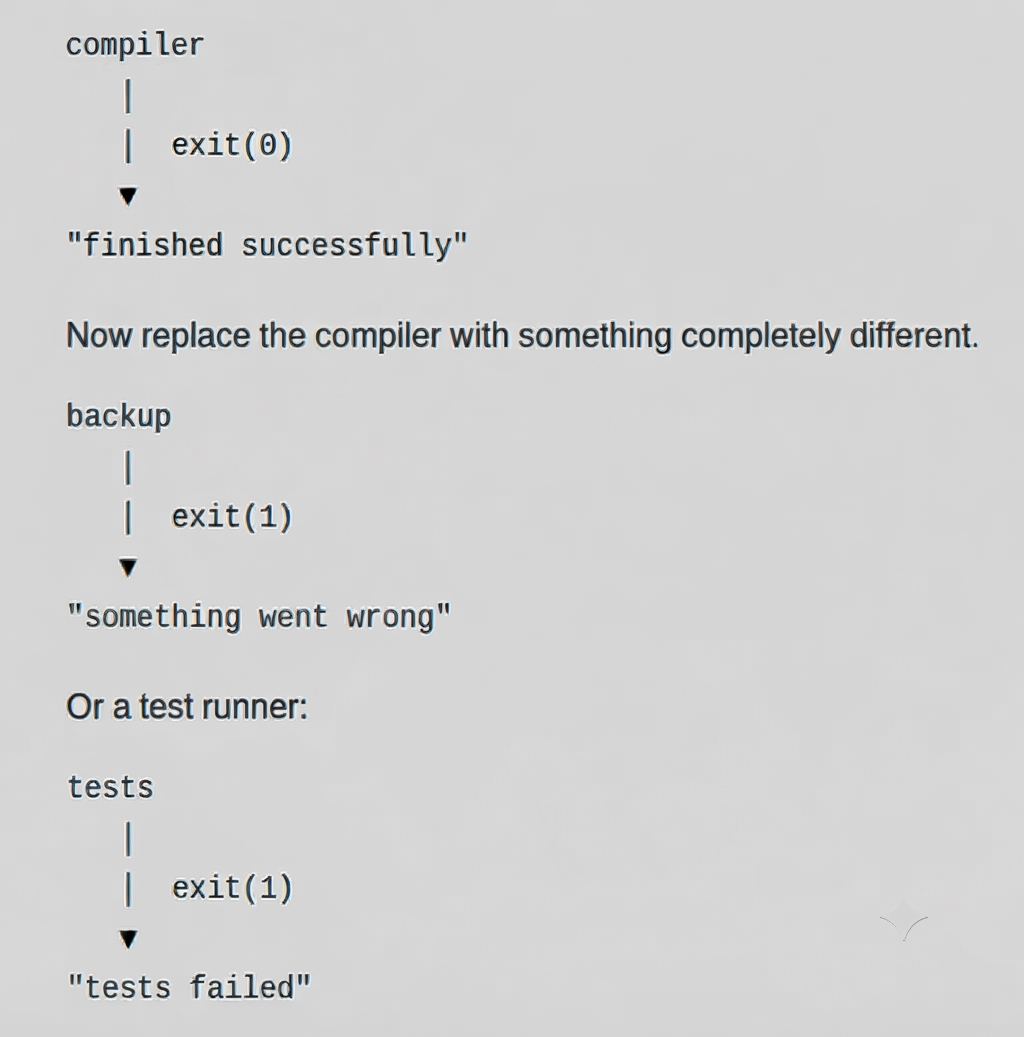
0        → success
non-zero → something went wrong
Why 0?
Because it makes the status useful as a simple condition. If the result is zero, carry on. If it isn't, something needs attention.
The exact non-zero value can carry more information, but most of the time, the caller doesn't need to care. It just needs the distinction between:
       Did it work?
        /       \
      yes        no
       │          │
       0       non-zero
And suddenly, a tiny integer has become a shared vocabulary between programs.
One program says:
"I'm done. Here's how it went."
The shell says:
"Got it. Here's what I'll do next."
Neither needs to know much about the other. That is a surprisingly powerful property for something so small. And it helps explain why this convention stuck around.
But there's a catch.
We've been treating the status as though it simply means success or failure.
A process doesn't always get to choose how it dies.
Sometimes, something else kills it.
And when that happens, the little number starts telling a much stranger story.
Fifty years later...
The machines are different. The operating systems are different. The programs are different. The scale is almost impossible to compare.
A program that once ran on a machine with a fraction of the resources we take for granted can now be running inside a container, orchestrated by Kubernetes, triggered by a CI pipeline, launched by a shell, and sitting somewhere behind several layers of infrastructure.
We've built abstractions on top of abstractions on top of abstractions.
And yet, underneath all of that, the basic conversation still looks remarkably familiar.
A process starts.
It does some work.
It terminates.
And it leaves behind a status.
For example:
$ ./build.sh
Building application...
Running tests...
Tests passed.

$ echo $?
0
That 0 doesn't look particularly impressive.
But look at what just happened.
A modern build script may have:
compiled hundreds of files,
invoked several different programs,
contacted external services,
run a test suite,
generated artifacts,
and performed a dozen other operations.
Yet when the whole thing is finished, one of the most important pieces of information it can give its caller is still:
0
And if something goes wrong:
1
or perhaps another non-zero value.
That same idea has quietly become part of the machinery underneath modern software.
The interesting part isn't that it survived
It's tempting to look at this and say:
"Unix was popular, so everyone kept using its conventions."
That's part of the story. But it isn't the interesting part.
The interesting part is why the interface was capable of surviving in the first place.
It doesn't make assumptions about the program producing it.
It doesn't make assumptions about the program consuming it.
It doesn't care whether the process was written in C in 1975 or Rust in 2026.
It doesn't care whether the caller is a human typing commands into a terminal or an automated system managing a deployment.
The contract is tiny:
I am finished.
Here is my status.
That's it.
And perhaps that is the real lesson hiding behind the exit code.
We tend to think of old software interfaces as things that survive because nobody bothered to replace them. And Sometimes that's true.
But sometimes they survive because they were small enough, generic enough, and useful enough that replacing them would solve almost nothing.
A number is not very expressive.
That's precisely why it can be used almost anywhere.